For years, tokenization was one of those ideas that seemed permanently stuck between the future and the present.
Banks talked about putting bonds on blockchains. Asset managers experimented with tokenized funds. Startups built platforms for tokenized real estate, private credit and treasuries. Crypto companies talked about bringing stocks and other traditional financial assets on-chain.
The technology was ready.
The bigger question was whether the financial system, regulators and institutions were ready to use it at scale.
That conversation has started to change.
In September 2026, the U.S. Securities and Exchange Commission granted temporary, conditional five-year exemptive relief to certain distributed-ledger trading venues dealing in tokenized NMS stocks and to certain liquidity providers operating on those venues. The framework is specifically designed around permissioned tokenized-stock trading venues and automated market-maker liquidity infrastructure. It is not a blanket five-year exemption for every tokenized asset, but it is an important regulatory development for companies building blockchain-based securities infrastructure.
The significance of this development goes beyond the five-year period itself.
It is another indication that regulators are no longer treating blockchain-based financial infrastructure simply as an experimental corner of crypto. The discussion is increasingly moving toward a more practical question: how should traditional financial assets operate when their ownership, transfer and settlement processes are represented through programmable blockchain infrastructure?
That question brings tokenization directly into the world of cybersecurity.
Because once a financial asset becomes programmable, the code controlling that asset becomes part of the financial infrastructure.
A vulnerability in a token contract can potentially affect ownership.
A vulnerability in an eligibility registry can potentially allow an unauthorized investor to acquire a restricted asset.
A compromised upgrade administrator can potentially change the rules of an already-issued security.
A flaw in an oracle can cause an on-chain system to act on incorrect information about an off-chain asset.
And a vulnerability in a tokenization factory can potentially affect not one asset, but every asset subsequently created through that infrastructure.
This is why the next stage of tokenization will not be defined only by how many assets can be put on-chain.
It will be defined by how securely those assets can remain on-chain.
From Bitcoin to Tokenized Financial Markets
The original promise of blockchain was relatively simple: create a shared system for recording ownership and transferring value without requiring every participant to maintain a separate database.
Bitcoin demonstrated that this model could work for a native digital asset.
Tokenization takes the same underlying idea and applies it to something that already exists outside the blockchain.
Instead of creating a completely new asset, a platform creates a blockchain representation of an existing financial or real-world asset.
That asset might be a U.S. Treasury security, a corporate bond, an investment fund, private credit, real estate, an equity interest or another financial instrument.
But there is an important distinction that is often lost in the marketing around tokenization.
Putting a token on a blockchain does not automatically put the underlying asset on the blockchain.
The building, bond, share, fund or treasury security still exists within the traditional financial and legal system.
The blockchain records something about the relationship between the holder and that underlying asset.
That relationship can take several forms.
In one structure, the token may represent an interest issued directly by the asset issuer. In another, an intermediary or special-purpose vehicle may hold the underlying asset and issue tokens representing an economic or beneficial interest. In another, the token may provide synthetic exposure to the price of an asset without giving the holder the same legal rights as ownership of the underlying security.
Those differences are not merely legal wording.
They determine what the token actually means.
They determine who has rights.
They determine who is responsible for custody.
They determine how redemption works.
And they determine what happens if something goes wrong.
The SEC’s January 2026 statement on tokenized securities explicitly discusses these different structures and distinguishes securities tokenized by or on behalf of their issuers from securities tokenized by unaffiliated third parties.
That distinction becomes increasingly important as tokenization moves from experimentation toward institutional infrastructure.
Why the SEC’s Five-Year Framework Matters
The September 2026 SEC relief is particularly interesting because it addresses one of the areas where tokenization becomes much more complicated: secondary-market infrastructure.
Creating a token representing an asset is only one part of the problem.
A functioning financial market also needs mechanisms through which participants can buy, sell and provide liquidity.
Traditional securities markets have spent decades developing exchanges, brokers, clearing systems, custodians, transfer agents and settlement infrastructure around these activities.
Tokenization potentially changes the technical architecture.
A tokenized security can interact with blockchain-based trading systems and, under appropriate structures, automated market makers and liquidity pools.
That creates an entirely different engineering environment.
Instead of a traditional centralized database being the only place where the transaction state exists, parts of the trading and settlement process can become programmable.
The SEC’s September 2026 order provides conditional relief for certain Tokenized Securities Venues and certain liquidity providers, subject to the conditions specified in the order. The relief is temporary and lasts for five years.
The wording matters.
This is not:
“All tokenized securities are exempt for five years.”
It is a targeted regulatory framework for particular market structures.
The order also distinguishes tokenized NMS stock from products that merely provide synthetic exposure to the price of an underlying stock.
For builders, that distinction should be treated as an architectural requirement.
Before writing the first smart contract, a tokenization platform needs to understand what the token actually represents.
Is it the security itself?
Is it an interest in an entity that owns the security?
Is it a beneficial interest?
Is it a claim against an issuer?
Or is it simply a derivative or synthetic representation of price exposure?
The answer affects almost every other component of the system.
Tokenization Is More Than an ERC-20 Contract
One of the easiest mistakes in tokenization is to look at the blockchain layer and assume that the token contract is the entire product.
It is not.
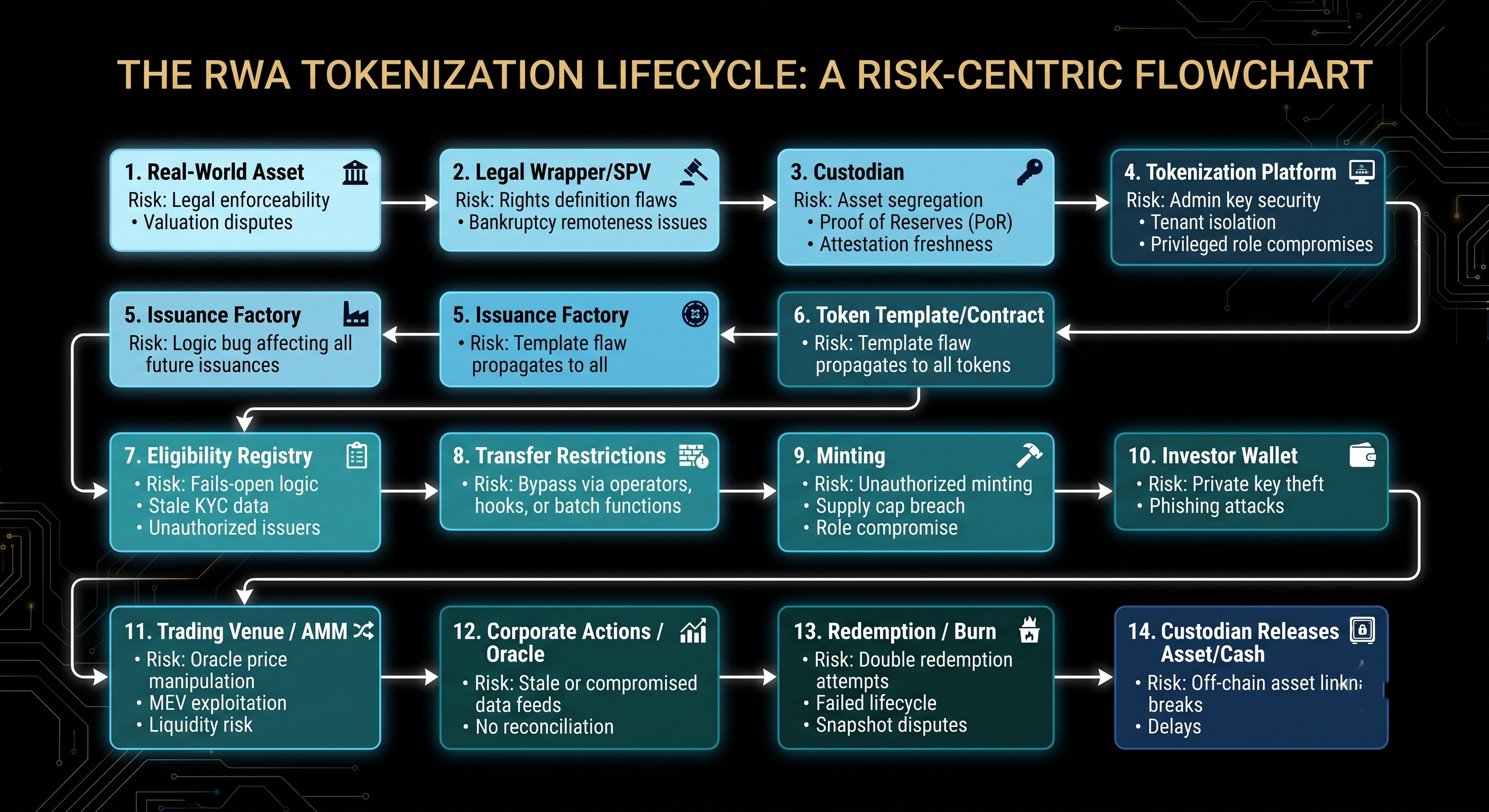
A serious tokenization platform is closer to a financial operating system.
At one end is the real-world asset.
At the other is the investor’s blockchain wallet.
Between those two points sits an entire chain of infrastructure.
There may be an issuer, custodian, identity provider, compliance engine, eligibility registry, token contract, oracle, settlement system, trading venue and redemption mechanism.
The blockchain is therefore only one part of the architecture.
Consider a simplified example.
Suppose a company wants to tokenize a private credit fund.
An investor first needs to pass the platform’s onboarding process.
The platform verifies the investor’s identity and determines whether that investor is eligible to hold the particular asset.
The investor’s wallet is then associated with that eligibility status.
The token contract checks the relevant permissions before allowing a transfer.
The fund’s assets remain with a custodian.
External information about the fund, such as NAV or corporate actions, may need to reach the blockchain through an oracle or attestation mechanism.
Eventually, the investor may want to redeem the token.
At that point, the system must connect the blockchain ownership record back to the traditional financial system.
The smart contract is important.
But it is only one link in the chain.
And every link creates a potential security boundary.
The Security Problem Begins With the Relationship Between the Token and the Asset
Imagine a platform has issued one million tokens representing interests in an underlying asset.
The blockchain says there are one million tokens.
The platform’s database says there are one million tokens.
But the custodian only holds assets corresponding to 900,000 tokens.
The smart contract can still be completely correct.
Every transaction can execute exactly as programmed.
The blockchain can remain perfectly consistent.
The system can nevertheless be financially wrong.
This is one of the fundamental challenges of real-world asset tokenization.
Blockchains are very good at maintaining consistency about information that exists on-chain.
They cannot independently prove that an off-chain asset exists.
That requires another layer of trust.
The system may therefore depend on a custodian, auditor, attestation provider, oracle, issuer or other external source.
This creates what is arguably one of the most important security boundaries in tokenization:
the connection between on-chain state and off-chain reality.
A secure tokenization architecture needs to understand that boundary explicitly.
How is the asset verified?
How frequently is the information updated?
Who signs the attestation?
What happens when the information becomes stale?
What happens if the data provider is compromised?
What happens if the custodian and blockchain records disagree?
What happens if an oracle stops responding?
These are not questions that can be answered by checking whether transfer() contains the correct access modifier.
They require architecture-level security analysis.
The Factory May Be More Important Than the Token
There is another reason tokenization platforms require a different approach to auditing.
Many platforms are designed to create multiple tokenized assets from shared infrastructure.
A factory deploys tokens.
A common implementation defines their behavior.
A registry determines investor eligibility.
A platform administrator manages upgrades.
This architecture is efficient.
It is also dangerous if the shared components are compromised.
Imagine a platform has 500 tokenized assets.
Each asset uses the same factory and implementation architecture.
A vulnerability in one token might affect a single issuance.
A vulnerability in the factory could affect every future issuance.
A vulnerability in an upgrade mechanism could potentially affect existing issuances as well.
This creates a very different security model from auditing an isolated DeFi contract.
The question is no longer simply:
“Can this token be exploited?”
The question becomes:
“What is the blast radius if this shared component is compromised?”
That is one of the central security questions Safe Edges focuses on when reviewing tokenization infrastructure.
The factory, templates, upgrade mechanisms, eligibility systems and privileged roles need to be understood as a single security architecture rather than independent contracts.
Compliance Logic Eventually Becomes Code
Traditional financial compliance is often expressed in documents and procedures.
Tokenization creates an opportunity to enforce parts of those requirements directly through software.
For example, a platform might determine that only investors who satisfy specific eligibility conditions can acquire a particular asset.
The system can encode that requirement into a transfer restriction.
Conceptually:
Investor → Identity → Eligibility → Wallet → Token Transfer
This is powerful.
It is also a new attack surface.
If the identity registry incorrectly marks an address as eligible, the token may accept the transfer.
If the registry can be manipulated by an unauthorized administrator, an attacker may not need to exploit the token itself.
If a revoked investor remains marked as eligible, the transfer restriction can fail even though the underlying smart contract is operating exactly as designed.
The security of the token therefore depends partly on the security of the systems it trusts.
This is one of the biggest differences between a conventional token audit and a tokenization-platform security review.
The auditor needs to understand trust relationships, not just individual functions.
Upgradeability Changes the Security Model
Institutional financial infrastructure is rarely static.
Contracts may need upgrades.
Compliance requirements may change.
New asset types may be introduced.
New integrations may be added.
But upgradeability introduces a fundamental question:
Who has the power to change the rules after investors have already deposited capital?
If an administrator can replace an implementation contract, that administrator may effectively control a large portion of the system’s future behavior.
That does not automatically make upgradeability unsafe.
It means the upgrade mechanism itself becomes one of the most important security components.
A security review therefore needs to examine the complete upgrade path.
Who controls the proxy?
Who controls the implementation?
Can the implementation be changed instantly?
Is there a timelock?
Is governance involved?
Can storage layouts change?
Can an upgrade alter transfer restrictions?
Can an upgrade change redemption logic?
Can an administrator upgrade one issuer’s contract without affecting another?
These questions become particularly important when one platform serves multiple institutions.
The Multi-Tenant Problem
Imagine a tokenization company provides infrastructure to ten asset issuers.
Issuer A tokenizes a bond.
Issuer B tokenizes a private fund.
Issuer C tokenizes a real-estate vehicle.
All three use the same underlying platform.
This creates a multi-tenant security model.
Issuer A should not be able to access Issuer B’s assets.
Issuer B should not be able to modify Issuer C’s configuration.
A compromised administrator for one asset should not automatically become an administrator for every other asset.
A vulnerability in one deployment should not silently propagate through shared infrastructure.
This sounds obvious.
But platform architecture can make these boundaries surprisingly difficult to enforce.
The security review therefore needs to look at tenant isolation as seriously as access control within an individual contract.
For institutional tokenization, isolation is not simply an engineering convenience.
It can become a core financial security property.
Redemption Is Where Tokenization Meets Reality
Issuance receives most of the attention because it is the visible part of tokenization.
Redemption is arguably more revealing.
A token has value because the holder expects the system to honor the rights associated with it.
If the token represents a redeemable asset, the platform needs a reliable mechanism for turning the blockchain record back into the corresponding financial or economic value.
That creates a complete lifecycle:
Issuance → Holding → Transfer → Corporate Action → Maturity → Redemption
Every stage can contain different security assumptions.
Suppose a bond reaches maturity.
The token must no longer behave like an active bond.
Suppose a fund distributes income.
The platform must determine who was entitled to receive it.
Suppose an investor transfers the token immediately before a distribution snapshot.
Who receives the payment?
Suppose a redemption transaction fails halfway through execution.
Can the investor retry?
Can the investor accidentally receive the value twice?
These are financial-state-machine problems.
They require invariant testing and adversarial analysis, not just conventional unit tests.
The Future of Tokenization Will Depend on Security Assurance
Institutional investors are unlikely to evaluate tokenization platforms solely by asking whether the token contract has been audited.
They will increasingly need answers about the entire infrastructure.
Who controls the keys?
Who can mint?
Who can burn?
Who can pause?
Who can force-transfer?
Who can upgrade?
How is investor eligibility established?
How is the underlying asset verified?
What happens if an oracle fails?
What happens if a custodian becomes unavailable?
What happens if an administrator is compromised?
Can one issuer affect another?
Can a vulnerability in a shared implementation affect every issuance?
Can the system recover from a compromised privileged account?
These are infrastructure questions.
And that is why tokenization security is becoming a specialized security discipline.
Where Safe Edges Fits
At Safe Edges, we approach tokenization platforms as complete financial infrastructure rather than treating the token contract as an isolated piece of Solidity.
The review begins with the architecture: what the token represents, how the underlying asset is connected to the blockchain, which components are trusted and where privileged authority exists.
The technical review then moves through the contracts and infrastructure that enforce those assumptions.
That can include token implementations, issuance factories, transfer restrictions, eligibility registries, upgrade mechanisms, administrative roles, oracle and attestation integrations, custody interfaces, redemption logic and the boundaries between different issuers.
The objective is to identify not only conventional smart-contract vulnerabilities, but failures in the assumptions connecting the components.
For example, a token may correctly enforce an eligibility registry.
The security question is then whether that registry itself can be manipulated.
A factory may correctly deploy token contracts.
The security question is whether an unauthorized party can control the configuration of future deployments.
An upgrade system may function technically.
The security question is whether the upgrade authority can silently change critical investor protections.
A redemption contract may correctly calculate balances.
The security question is whether an attacker can manipulate the lifecycle around the calculation.
This is the difference between reviewing code and reviewing a system.
Safe Edges’ tokenization security approach is designed around that broader platform view, including issuance infrastructure, token templates, transfer restrictions, identity and eligibility systems, privileged roles, tenant isolation and the connection between on-chain representations and off-chain assets.
Tokenization Is Becoming a Security Problem as Much as a Financial One
The most important development in tokenization is not simply that more assets are being represented on blockchains.
It is that blockchain infrastructure is increasingly being connected to systems that already carry significant financial value.
That changes the consequences of a security failure.
A vulnerability in a speculative token may result in a loss.
A vulnerability in institutional tokenization infrastructure can potentially affect ownership records, investor eligibility, settlement, redemption, corporate actions or multiple issuances simultaneously.
That is why the industry’s security model has to mature alongside its regulatory model.
The SEC’s five-year conditional relief provides one piece of that evolving environment.
The broader movement toward tokenized securities and real-world assets provides another.
But regulatory clarity alone cannot make tokenization secure.
And smart-contract auditing alone cannot solve every problem either.
The real challenge lies between the two worlds:
legal rights, financial assets, institutional controls and programmable blockchain infrastructure must remain consistent with each other.
That is the standard tokenization infrastructure will ultimately have to meet.
The future of tokenized finance will not be determined simply by how many assets can be put on-chain.
It will be determined by whether institutions can trust what happens after they are there.