
In Web3, security failures rarely start with a headline. They often begin quietly, inside ordinary development workflows: a copied wallet address, a deployer key, a dependency update, a generated script, a local config file, or a developer machine that becomes part of the attack path.
April 2026 made that reality impossible to ignore. Crypto security reports tracked more than $600 million in losses across nearly 30 incidents in a single month. Drift Protocol and KelpDAO accounted for most of the damage. Drift was reported as an admin-key compromise linked to social engineering, while KelpDAO’s rsETH bridge incident showed how compromised infrastructure and weak verification assumptions can cascade into hundreds of millions in losses. At the end of the month, Wasabi Protocol was also hit by an admin-key compromise, draining more than $5 million across multiple chains.
The message is clear:
Attackers are not only looking for vulnerable contracts. They are looking for the keys, tools, packages, and workflows around those contracts.
That is why Safe Edges built Bastion Security.
Bastion Security is Crypto Private Key Protection for Web3 developers. It helps teams detect leaked private keys, seed phrases, suspicious dependencies, crypto-stealer patterns, risky code behavior, and sensitive clipboard mismatches directly inside the developer workflow.
The Problem
Web3 teams operate in a world where one small mistake can become irreversible.
A leaked API key can be rotated. A leaked password can be reset. A leaked private key can drain a wallet, compromise a deployer, transfer ownership, or unlock critical protocol infrastructure.
There is no password reset for a drained wallet. There is no chargeback for a stolen treasury. There is no undo button after an attacker signs the right transaction.
And the risk is no longer limited to production contracts.
It can start with:
- a private key pasted into a test file
- a seed phrase saved in local notes
- a deployer key stored in a config
- a malicious dependency added during setup
- a generated script that sends secrets to a remote endpoint
- a wallet address changed during copy-paste
- a local development machine becoming the first point of compromise
Generic security tools are useful, but Web3 has different failure modes. Bastion was built for those failure modes.
Why Safe Edges Built Bastion
Safe Edges built Bastion because Web3 developers need protection at the moment mistakes happen, not only after code is committed, scanned, audited, or deployed.
By the time a leaked key reaches GitHub, CI, a package, or a production script, the damage may already be in motion.
The better place to catch it is earlier:
- while the code is being written
- while a dependency is being added
- while a generated snippet is being reviewed
- while a wallet address is being pasted
- while a developer is still inside the editor
That is the core idea behind Bastion:
Move crypto security closer to where crypto mistakes begin.
What Bastion Security Does
Bastion Security helps developers detect high-risk crypto security patterns inside their editor before they become incidents.
It helps catch:
- private-key-like strings
- seed-phrase-like text
- high-entropy encoded secrets
- suspicious token-like credentials
- risky dependency and package patterns
- code that may combine sensitive values with network calls
- clipboard mismatch behavior during sensitive address workflows
The goal is simple:
Catch leaked keys, crypto-stealer patterns, and risky dependencies before they leave the developer workflow.
Private Key and Seed Phrase Protection
Private keys and seed phrases are among the most dangerous values that can appear in a Web3 codebase.
They often enter by accident:
- pasted into test code
- saved in .env or config files
- copied into scripts during debugging
- committed in a rushed change
- generated during local development
- left inside temporary files or notes
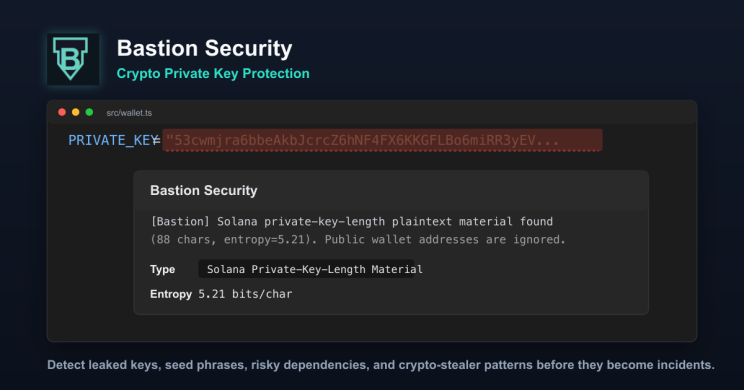
Bastion scans active files for private-key-like strings, seed phrases, and high-entropy secret patterns. When something looks risky, it surfaces diagnostics directly in the editor and Problems panel so developers can act immediately.
Crypto Stealer Pattern Detection
Modern crypto stealers often follow a simple pattern:
Find sensitive data. Package it. Send it somewhere.
That “somewhere” could be a webhook, an unknown API endpoint, a malicious package, a hidden script, or a compromised dependency.
Bastion helps flag risky code behavior, especially when sensitive values appear near outbound network calls. This is useful when reviewing scripts, package changes, generated code, automation, or unfamiliar project files
The point is not to slow developers down. The point is to make fast development safe
Supply Chain Guard for Web3 Projects
Web3 teams move fast, and open-source packages make that possible. But the same dependency graph that helps teams ship quickly can also become an attack path.
Typosquatting, dependency confusion, malicious maintainers, and compromised package updates are all realistic threats.
For Web3 projects, a single malicious dependency can become:
- a wallet drainer
- a secret collector
- a transaction manipulator
- a build-time exfiltration tool
- a hidden post-install risk
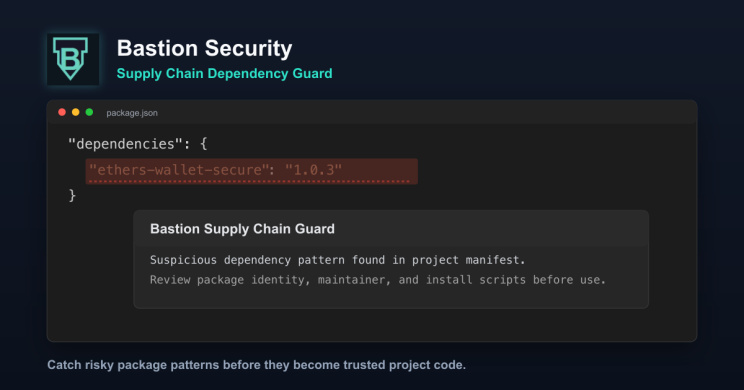
Bastion monitors project files, manifests, and dependency patterns for suspicious supply-chain signals, giving developers a chance to pause before a risky package becomes trusted code.
Clipboard Consistency Reminder
Crypto developers copy and paste sensitive values constantly:
- contract addresses
- treasury addresses
- recipient addresses
- RPC endpoints
- deployment values
- token addresses
- wallet addresses
Clipboard attacks and accidental paste mismatches are easy to overlook, but they can be expensive.
Bastion includes a clipboard consistency reminder that keeps a temporary in-memory copy of recently copied text and warns when pasted text differs from what was being tracked.
It is a small guardrail for a high-stakes workflow.
Built Local-First
Security tools should not become another data leak.
Bastion is designed with a local-first approach:
- checks run inside the editor extension host
- review data is bundled with the extension
- project data is not automatically uploaded for runtime updates
- developers stay in control of their code
This matters because the tool protecting secrets should not create another secret exposure path.
Who Bastion Is For
Bastion Security is built for:
- Web3 developers
- DeFi teams
- smart contract engineers
- wallet builders
- crypto founders
- protocol teams
- security researchers
- open-source maintainers
anyone working with private keys, seed phrases, wallet addresses, or blockchain credentials
If your code can move assets, sign transactions, deploy contracts, manage wallets, or touch protocol infrastructure, your development environment is part of your security perimeter.
Bastion helps defend that perimeter.
Why Now
April 2026 was a warning, but the pattern has been building for years. Attackers are moving closer to developers because that is where trust begins.
KelpDAO showed how one failure in infrastructure trust assumptions can trigger massive downstream damage. Drift showed how admin-key compromise and social engineering remain catastrophic. Wasabi showed again that compromised admin or deployer access can drain funds across chains.
These are not isolated edge cases. They are reminders that crypto security has to start before deployment, before audit, before CI, before GitHub, and before the transaction.
It needs to start where mistakes begin:
inside the developer workflow.
Install Bastion Security
Bastion Security is available on the Visual Studio Marketplace and works with VS Code-compatible editors.
To install in Cursor, open the Extensions panel and search
Bastion Security
or search by extension ID:
SafeEdges.bastion-security
Closing
Web3 does not need another passive scanner that tells you about risk after the damage is already moving.
It needs protection closer to where mistakes begin.
Bastion Security brings Crypto Private Key Protection into the developer workflow, helping teams catch leaked keys, risky dependencies, suspicious exfiltration patterns, and sensitive clipboard mismatches before they become incidents.
Built by Safe Edges , Bastion exists for teams who know that in crypto, one secret can be the whole system.
Sources: Blockaid on KelpDAO, EconoTimes April 2026 hack summary, BeInCrypto on Wasabi, Bitcoin.com on DefiLlama April hack data.